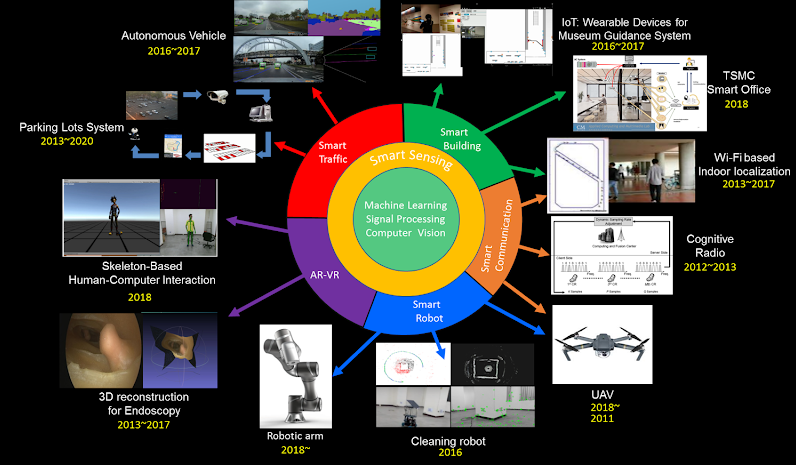
Research Overview
Our research at the UTE AI Laboratory focuses on developing intelligent systems that combine Machine Learning, Signal Processing, and Computer Vision. These technologies form the core of our efforts and are applied across diverse domains to solve real-world problems.
Main Research Domains
- Smart Traffic: Developing autonomous vehicles and intelligent parking systems to improve transportation safety and efficiency.
- Smart Sensing: Using sensor fusion and AI to understand environments—examples include smart offices, indoor localization, and wearable systems.
- Smart Building: Integrating AI into buildings to create responsive and efficient smart environments.
- Smart Communication: Enhancing wireless systems using AI techniques, such as in cognitive radio and network optimization.
- Smart Robot: Designing and deploying robotic systems, such as robotic arms, cleaning robots, and UAVs (drones), to automate tasks.
- AR/VR: Enabling natural human-computer interaction through skeleton-based pose recognition in virtual environments.
- 3D Medical Imaging: Reconstructing internal anatomy via 3D vision techniques for use in endoscopy and diagnostics.
Highlighted Projects and Timelines
- 🚗 Autonomous Vehicle (2016–2017): Developing self-driving prototypes for navigating complex environments.
- 🅿️ Parking Lot System (2013–2020): Intelligent vehicle monitoring and management in parking areas.
- 🧍♂️ Human-Computer Interaction (2018): Skeleton-based gesture recognition using depth sensors.
- 🧠 Cognitive Radio (2012–2013): AI-enhanced wireless communication systems for adaptive frequency usage.
- 📦 IoT & Smart Office (2016–2018): Projects integrating AI and embedded devices for space utilization and user interaction.
- 🔍 3D Endoscopy (2013–2017): Vision-based medical reconstruction for internal visualization.
- 🦾 Robotic Arm (2018–): Precision manipulation systems for industrial or assistive use.
- 🧹 Cleaning Robot (2016): Autonomous floor-cleaning robots using navigation and obstacle avoidance.
- 🚁 UAV (2011 & 2018–): Aerial drones for vision-based navigation and object detection.
These projects represent a multidisciplinary approach that leverages cutting-edge AI research to address practical challenges in transportation, healthcare, robotics, and communication.